Cautionary Tale
The Aging of Jessie Daniel Ames

In 1885, women’s suffrage activist Elizabeth Cady told an audience assembled to mark her seventieth birthday that “The pleasures of age depend on what constitute the threads of our lives and how they are woven together.” In previous posts, I’ve written about several women who wove threads of creativity, intellectual flowering, and connection with loved ones into a vibrant and satisfying old age. But other women struggled to overcome early challenges that hardened into patterns of isolation and frustration. One example was activist Jessie Daniel Ames. By her own account, Ames suffered a lifelong fear of intimacy that hampered her ability to bond deeply with family and friends alike. Emotional isolation combined with financial struggles, the early end of her career, and failing health to fill Ames’s final with heartache and unhappiness. If women like psychologist Ida Davidoff and artist Olive Damon offer inspiring role models for aging, Jessie Daniel Ames offers a counterpoint.
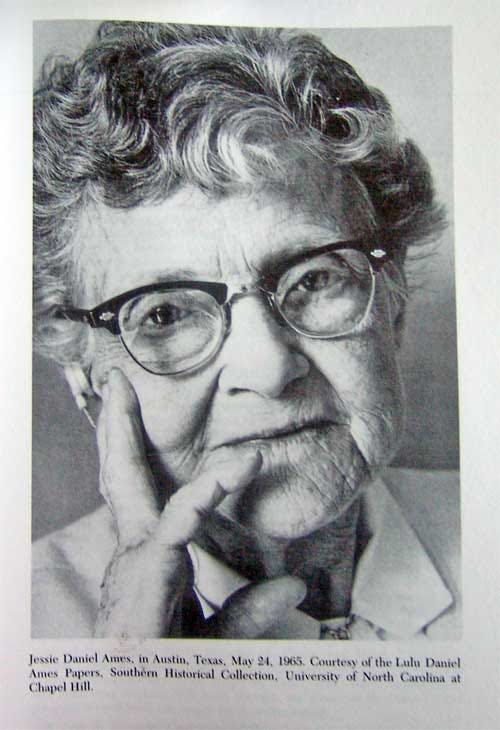
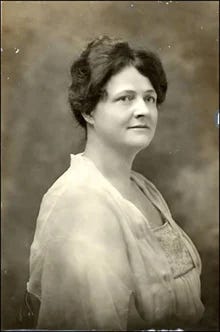
Ames was born in Texas in 1883, the fourth of three children.[i] Her father openly favored Jessie’s older sister, a source of great pain to Jessie. After graduating from Southwestern University in Georgetown, Texas, Jessie married Roger Ames, an army surgeon 13 years her senior. The marriage was an unhappy one, and the couple lived apart much of the time. While working in Guatemala in 1914, Roger Ames died of an infectious disease called blackwater fever, leaving Jessie with a son, a daughter, and another daughter on the way. Historian Jacquelyn Dowd Hall has written that the combination of her relationship with her father and her unhappy marriage had trapped Ames “in permanent and painful emotional isolation.” Hall added that “the major theme of her emotional life became the need for control—over herself, her children, her surroundings.” Ames later wrote, “Since the day of my husband’s death, I have put on a bold front to prevent anyone’s feeling sorry for me.”[ii]
After Roger’s death, Ames supported her family by working for the Georgetown, Texas, telephone company owned by her mother. She also became active in the Texas movement for women’s suffrage and the state and national Democratic Party.
In 1920, the same year that saw the passage of the Nineteenth Amendment which granted women the right to vote, fate struck a cruel blow on Jessie Ames. Her youngest daughter Lulu, age five, was stricken with polio. The child was hospitalized for weeks and underwent years of painful treatments and repeated surgeries. Jessie became a fierce advocate for her daughter’s care and education, but the cost of Lulu’s care added to the family’s financial strain.
Even as she shouldered responsibilities as a single mother, Ames remained an activist, turning her energies to issues of racial justice. In 1922, she became an officer in the Texas chapter of the Commission on Interracial Cooperation (CIC), an Atlanta-based civil rights organization formed in the wake of World War I-era race riots. Ames’s prodigious organizing skills caught the attention of CIC leaders, and in 1929, she was hired as the CIC’s director of women’s work. She moved her family to Atlanta. Ames soon founded the Association of Southern Women for the Prevention of Lynching (ASWPL), an organizing and lobbying arm of the CIC. Ames was a persuasive speaker, and she wrote two compelling books exposing the crime of lynching.[iii]
Then as now, older women often found themselves marginalized in the workplace as they aged. In 1944, after years of dedicated service to CIC, a reorganization led to a reduction in Ames’s salary and her responsibilities. Frustrated and angry, Jessie resigned from her job at the age of 61.
Ames purchased a cottage called “The Wren’s Nest” in Tryon, North Carolina. Here she continued her activism. She organized a group of local women to wrest control of the local Democratic party from a courthouse gang. She registered black voters and becoming a regular speaker on world affairs to Methodist Church groups in western North Carolina. She churned out multiple versions of an autobiography which was never published. She also struggled to make ends meet, taking occasional temporary teaching jobs to supplement her savings. Her children often sent her money, sometimes at Jessie’s own request.
After her move to Tryon, Ames floundered. Her story is a cautionary tale about what could happen when a woman whose life had been filled with purposeful activity lost her sense of mission and her public affirmation. Jessie kept carbon copies of much her personal correspondence, and her letters document her unhappiness. In 1948, she wrote to daughter Mary that “Living alone without occupation fitted to one’s talents is pretty grim business and I know it.”
Living alone without occupation fitted to one’s talents is pretty grim business and I know it.
Ames’ final decades were marked by conflicts with her children. Frederick, her eldest child, a physician, lived in Texas. Middle child Mary also became a physician, a pediatrician noted for her pioneering work with children with physical disabilities. She practiced in Harrisburg, Pennsylvania. Lulu lived in Austin and worked as an editor.
In January 1946, Jessie wrote to Frederick about their “misunderstandings and alienation.” At least some of the alienation was rooted in Jessie’s expectation that her children provide her with financial support. She frequently referred to her own financial struggles as a single parent. One letter mentioned Frederick’s resentment that she had kept “the books on the cost of his education,” a reference to the fact that Ames kept a record of how much she spent on her children’s higher education with the expectation that they repay her later in life. Another letter expressed her hope that he and Mary would return the “investment made in the past” in order to enable Jessie to live in her own home. Jessie also disliked Frederick’s wife Hope and at one point referred to her own love for Frederick as a “possessive love.” She refers to unpleasant confrontations on occasions when she was an overnight guest in Frederick’s home.
Frederick wrote his mother regularly, but his letters ignore her anger and the estrangement, instead offering brief reports on his activities, his medical practice, and news of his two children with no emotional commentary. He seemed to avoid conflict, perhaps in an effort to keep the peace and maintain the relationship.
Ames sometimes commented on her strained relationship with Frederick in letters to her daughters. For example, in October 1947, she wrote to Mary that “I do have an occasional brain storm about Frederick. . . . When I have one, I write him a letter filled with venom, say all the bitter and hateful things that possess me and then mail it in the waste paper basket.”
Indeed, Jessie did not mail many of the recriminating letters she wrote to her children. In 1954, during a particularly acrimonious period in her relationships with them, Ames collected a series of letters in a file folder that she labeled “wailing wall letters.” In a note submitted with the files when Ames’s papers were sent to the Southern Historical Collection archives in Chapel Hill, daughter Lulu indicated “these are letters to the three of us that she wrote but did not mail and the [carbon copy of the] letter that she did mail, stapled together. . . . They are pretty rough but revealing of her mind, emotions, etc.”
At least in part, the wailing wall letters were precipitated by a rupture in Jessie’s relationship with Mary, which also centered on money. In 1948, a still-single Mary invested funds to repair The Wren’s Nest. In return, Jessie deeded Mary the house. In spring 1952, Jessie wrote to her daughter requesting that Mary and her husband return title to the house in exchange for a promise to include a clause in Jessie’s will to repay her. Mary refused the arrangement provoking Jessie to threaten to “vacate the place.”
The quarrel escalated over the next two years. The wailing wall letters expressed her resentment that her children conferred among themselves about “what shall we do with Mother,” ironic given that she often tried to draw each of the children into her conflicts with their siblings. She also wrote of her fear that the children believed that she was delusional or “losing her capacity to think,” her distress over the way “money has built a barrier between [Mary] and me,” and her sense of loneliness and isolation. One undated fragment lamented the strained relationships with all three children, concluding that “human nature being what it is, I must find some associations which give me a feeling of being welcomed and liked for myself. Associations with persons who make no drain on my emotions, whom I can take or leave alone.” She commented that she found this kind of relationships with her nieces and nephews, the children of her older sister. A few weeks later, another wailing wall letter read, “I am in my sevent-first year [sic]. I may live for ten or fifteen years longer. I must condition myself to live alone, not only in the body, but in my mind and my heart.”
Ames understood that her own actions were at the root of her strained relationships. In a demonstration of a high level of self awareness, she reflected on her lifelong struggles to maintain close relationships. She wrote, “I have spent too many years, almost all that I have lived, building up a stone wall between me and the people whom I love. My actions produce corresponding reactions to which I react and so am in a vicious cycle. And I am. . . so conscious now, that I cause all the hurt I get. . . . I have come to the conclusion that I am at present, unfit for family association.”[iv] It’s easy to imagine Jessie Ames, alone in Tryon, communicating with her children in far-flung states primarily by post. With each letter, you can imagine her ruminating, winding herself into knots.
She also wrote of her fear that the children believed that she was delusional or “losing her capacity to think,” her distress over the way “money has built a barrier between [Mary] and me,” and her sense of loneliness and isolation.
In spite of all the bitterness and recrimination, all three children continued to write to her and to send her gifts and money. In 1959, Frederick was diagnosed with cancer. Ames visited him, and they exchanged a series of warm and loving letters before his death in August of that year. Several letters document her deep sorrow over his death.
Throughout the 1960s, Jessie’s own health gradually deteriorated, largely due to worsening arthritis. She became less active in church and community work and devoted hours to reading history and books on world affairs. She was particularly concerned about the unfolding of American involvement in Vietnam. She engaged a part-time caregiver and companion but stoutly rejected suggestions that she needed someone to stay with her overnight, writing to Lulu, “I am not going to have anyone living with me ever at all. If the time comes that I can get no peace from you and Mary Ames and [Dr.] John Preston [her son-in-law], I shall repair myself to a HOME FOR THE AGED—quickly followed by suicide.”
In spite of her long insistence on living alone, in 1968, Ames moved in with Lulu in Austin. By this time, Lulu was confronting mobility issues brought on by post-polio syndrome. Eventually Jessie entered a nursing home where she died of pneumonia in 1972.
Jessie Daniel Ames’s life is a stark reminder of Stanton’s observation that “The pleasures of age depend on what constitute the threads of our lives and how they are woven together.” Our experience of our later years is shaped by a complex weaving of genetics, economics, social support systems, personal outlook, life experiences, and plain old luck (good and bad). For Ames, these threads wove together to create a sad old age. Starting from her early experience of being overshadowed by her much favored sister, Jessie Daniel Ames constructed layers of protective emotional armor that obstructed her ability to form satisfying relationships. In adulthood, she found purpose and meaning in her work as an activist, but when pushed out of her career at age 61, she struggled emotionally and financially. She often lashed out at those closest to her. Ames understood that her isolation and unhappiness were often self-inflicted wounds, but she was not able change the self-protective patterns of a lifetime. The wisdom embedded in her experience is more admonition than inspiration.
[i] Biographical information on Jessie Daniel Ames was drawn from Jacquelyn Dowd Hall, Revolt Against Chivalry: Jessie Daniel Ames and the Women's Campaign Against Lynching (New York: Columbia University Press, 1993); the Jessie Daniel Ames Papers, Southern Historical Collection, Wilson Library, University of North Carolina at Chapel Hill including the digital finding aids: https://finding-aids.lib.unc.edu/03686/ and assorted newspaper articles including obituaries.
[ii] Hall, Revolt Against Chivalry, pp. 15 and 16.
[iii] Although the ASWPL did not succeed in obtaining passage of a national anti-lynching law, Ames and her volunteers made progress in mobilizing public opinion against lynching. Lynching rates steadily declined in the 1930s. A law making lynching a federal hate crime, the Emmett Till Antilynching Act, was finally passed by the US Congress and signed into law by President Joe Biden in 2022.
[iv] Quoted in Hall, Revolt Against Chivalry, p. 263.
Photos in public domain courtesy of https://www.georgetown-texas.org/ and